


History of Halloween
Halloween is a great day for parties. Children dress up as witches, ghosts or vampires, and they go from house to house playing TRICK OR TREAT. But what’s the origin of this custom?
Halloween means Hallows’ Evening. It is the evening before All Hallows’ Day (now called All Saints Day), a Christian holiday, celebrated on the 1st of November. But that day was important already in ancient times. On the 1st of November, Celtic peoples celebrated the festival of Shamhuinn, which marked the beginning of winter and the Celtic New Year.
“How come a Christian and a pagan holiday are celebrated on the same day?” you might ask, “Is it just a coincident?” – No, it isn’t. When Christianity spread, the Church tried to disturb the pagan customs as little as possible, and so they merged their festivals with pagan ones.

It was widely believed that on Hallows’ Evening the dead would rise from their graves to roam the earth.
Afraid of evil spirits, people therefore either wore ugly masks to frighten those spirits away, or they stayed at home saying prayers.
Some would also go from house to house, begging for ‘soul cakes’, square pieces of bread with currants. In return they promised to pray for dead members of the donors’ families.
Going from house to house, begging for sweets – doesn’t that sound familiar? Indeed, that’s the origin of TRICK OR TREAT.
Be aware, however, as the custom has changed! Nobody is going to pray for you nowadays.
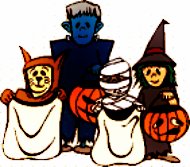 Instead, if you don’t have a TREAT for the children in front of your door (some sweets for example), they will most likely play a TRICK on you – that’s what TRICK OR TREAT is all about.
Ordinal Numbers
Table of Ordinal Numbers
| 1 | st | first | 11 | th | eleventh | 21 | st | twenty-first | 31 | st | thirty-first | ||
| 2 | nd | second | 12 | th | twelfth | 22 | nd | twenty-second | 40 | th | fortieth | ||
| 3 | rd | third | 13 | th | thirteenth | 23 | rd | twenty-third | 50 | th | fiftieth | ||
| 4 | th | fourth | 14 | th | fourteenth | 24 | th | twenty-fourth | 60 | th | sixtieth | ||
| 5 | th | fifth | 15 | th | fifteenth | 25 | th | twenty-fifth | 70 | th | seventieth | ||
| 6 | th | sixth | 16 | th | sixteenth | 26 | th | twenty-sixth | 80 | th | eightieth | ||
| 7 | th | seventh | 17 | th | seventeenth | 27 | th | twenty-seventh | 90 | th | ninetieth | ||
| 8 | th | eighth | 18 | th | eighteenth | 28 | th | twenty-eighth | 100 | th | one hundredth | ||
| 9 | th | ninth | 19 | th | nineteenth | 29 | th | twenty-ninth | 1,000 | th | one thousandth | ||
| 10 | th | tenth | 20 | th | twentieth | 30 | th | thirtieth | 1,000,000 | th | one millionth | ||
Form
Spelling of Ordinal Numbers
Just add th to the cardinal number:
- four - fourth
- eleven - eleventh

Exceptions:
- one - first
- two - second
- three - third
- five - fifth
- eight - eighth
- nine - ninth
- twelve - twelfth
In compound ordinal numbers, note that only the last figure is written as an ordinal number:
- 421st = four hundred and twenty-first
- 5,111th = five thousand, one hundred and eleventh
Figures
When expressed as figures, the last two letters of the written word are added to the ordinal number:
- first = 1st
- second = 2nd
- third = 3rd
- fourth = 4th
- twenty-sixth = 26th
- hundred and first = 101st
Titles
In names for kings and queens, ordinal numbers are written in Roman numbers. In spoken English, the definite article is used before the ordinal number:
- Charles II - Charles the Second
- Edward VI - Edward the Sixth
- Henry VIII - Henry the Eighth
Cardinal Numbers
Table of Cardinal Numbers
| 1 | one | 11 | eleven | 21 | twenty-one | 31 | thirty-one |
| 2 | two | 12 | twelve | 22 | twenty-two | 40 | forty |
| 3 | three | 13 | thirteen | 23 | twenty-three | 50 | fifty |
| 4 | four | 14 | fourteen | 24 | twenty-four | 60 | sixty |
| 5 | five | 15 | fifteen | 25 | twenty-five | 70 | seventy |
| 6 | six | 16 | sixteen | 26 | twenty-six | 80 | eighty |
| 7 | seven | 17 | seventeen | 27 | twenty-seven | 90 | ninety |
| 8 | eight | 18 | eighteen | 28 | twenty-eight | 100 | a/one hundred |
| 9 | nine | 19 | nineteen | 29 | twenty-nine | 1,000 | a/one thousand |
| 10 | ten | 20 | twenty | 30 | thirty | 1,000,000 | a/one million |
Separation between hundreds and tens
Hundreds and tens are usually separated by 'and' (in American English 'and' is not necessary).
110 - one hundred and ten
1,250 - one thousand, two hundred and fifty
2,001 - two thousand and one
Hundreds
Use 100 always with 'a' or 'one'.
100 - a hundred / one hundred
'a' can only stand at the beginning of a number.
100 - a hundred / one hundred
2,100 - two thousand, one hundred
Thousands and Millions
Use 1,000 and 1,000,000 always with 'a' or 'one'.
 1,000 - a thousand / one thousand
201,000 - two hundred and one thousand
Use commas as a separator.
57,458,302
Singular or Plural?
Numbers are usually written in singular.
two hundred Euros
several thousand light years
The plural is only used with dozen, hundred, thousand, million, billion, if they are not modified by another number or expression (e.g. a few / several).
hundreds of Euros
thousands of light years
Exercise
Halloweenorexia
An eating disorder that only proceeds a month before Halloween.
Mainly occuring in young women, characterized by a self-induced starvation in order to look hot in their Halloween costumes.
Halloweenorexia ends the following day and is usually followed by a food binge.
Not Even Under Threat!!
(por Adham elsissy)
Certas coisas em inglês você não deve falar NEM SOB AMEAÇA.
Então aqui estão algumas dessas coisas:
1-Verbo to be.
JÁ MAIS, NUNCA e claro NEM SOB AMEAÇA falar you is. é tão feio quanto Nóis é.
2-Nem eu. Em português é normal dizer eu também não. Por exemplo:
A: Eu não gosto de salada.
B: Eu também não.
Em inglês, NEM SOB AMEAÇA se deve responder uma frase negativa com me too.
A: I don`t like salad
B: Neither do I or I don`t either (ou ainda me either)
3-Sabemos que no presente, precisamos conjugar os verbos com He, She and It colocando um S no final do verbo. Que é a terceira pessoa do singular.
Ex.: He workS, She playS, It runS.... etc.
Só que NEM SOB AMEAÇA podemos falar He haveS. O verbo Have vira HAS.
4-Idade.
A: How old are you?
B: I AM 30 years old.
NUNCAAAAA NEM SOB AMEAÇA, podemos falar I have 30 yeas old ( ai voce corre o risco de apanhar, alguns alunos ate já sofreram ameaças de apanhar na aula, right? ) :D
5-Have.
O verbo have em inglês é sempre um verbo de posse, ao contrário do portugues que as vezes usamos o verbo Ter como auxiliar de uma frase.
Ex.: Tem bastante gente aqui hoje.
NEM SOB AMEAÇA podemos falar Have many people here today. Ai que entra There is e There are.
There are many people here today.
Bom, por hoje acho que só 
So, see you in class.
É NOIS.

Assinar:
Postagens (Atom)